

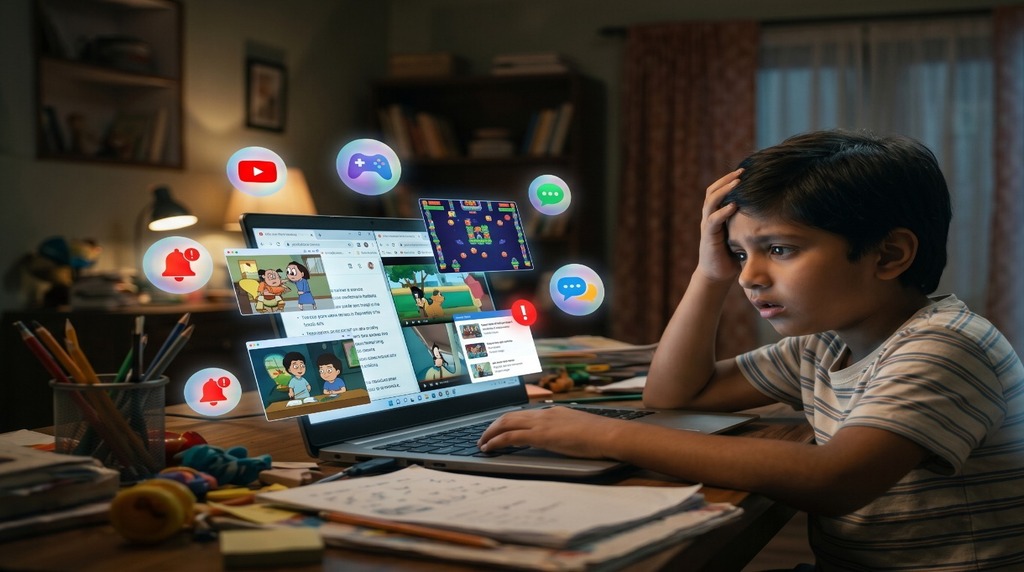
Picture this.
Your child sits at the computer for two hours every evening. Notebook open. Earphones in. Looks like studying.
But at the end of the week, they cannot explain a single concept from what they “learned.”
Sound familiar?
This is not a willpower problem. This is not a parenting failure. This is what happens when a child is given a powerful digital tool with no structure for how to use it.
Across India, millions of students now have access to computers, tablets, and the internet. But access alone does not create learning. Structure does. And right now, most children learning digitally have very little of it.
1. The Hidden Gap in Digital Learning Without Structure
The internet was not designed for children. It was designed to keep every user, adult or child, engaged for as long as possible.
Every platform, every app, every video feed is optimised to pull attention away from the last thing and onto the next. A student opens a YouTube science tutorial. Three minutes later, they are watching a gaming video. Not because they are lazy, but because the algorithm is doing exactly what it was built to do.
This is the core problem with unstructured digital learning. Without clear boundaries, the learning environment and the entertainment environment are the same device, the same browser, the same screen.
Research consistently shows that students in unstructured digital settings spend up to 40% of their screen time on non-educational content, often without realising they have drifted. The cost is not just lost time. It is a loss of confidence. Students begin to believe they cannot focus when the truth is that they were never given an environment that made focusing easy.
2. Why Traditional Report Cards Fail to Reflect Real Learning?
Here is a question most parents never think to ask: What does your child’s report card actually measure?
Marks. Attendance. Teacher remarks. Once every three months.
A traditional report card tells you the result of an exam taken on one specific day. It does not tell you how your child spends two hours on a screen every evening. It does not show whether they are building real skills or just consuming content. It does not capture effort, consistency, or digital behaviour at all.
This gap is becoming dangerous. In a world where a significant portion of learning now happens on devices, parents are navigating their child’s education almost entirely in the dark. The report card shows a 72%, but was that despite two hours of daily gaming, or because of genuine focused learning?
Without visibility into the digital learning process, parents cannot answer that question.
3. What Is a Digital Report Card and Why Does It Matter Today?
A digital report card completely changes this.
Unlike a traditional report card that measures outcomes, a digital report card tracks the learning process itself, session by session, day by day. It shows which platforms the student visited, how long they stayed focused, whether they attempted to access restricted content, and how their consistency has improved over time.
For Indian parents managing busy households, this is not about surveillance. It is about finally having honest, real information about what is happening on the screen, so they can support their child better rather than police them harder.
A digital report card answers the question every parent actually wants answered: “Is my child actually learning, or just sitting in front of a screen?”
4. How Parents Can Track Real Learning Beyond Screen Time
Screen time is the wrong metric.
Two hours of focused coding practice and two hours of drifting between YouTube videos are both “two hours of screen time.” They produce completely different outcomes. Parents who monitor only screen time are measuring the wrong thing entirely.
What actually matters is learning time, structured, focused, purposeful engagement with educational content.
To track real learning, parents need tools that go deeper than timers and usage reports. They need session-level data: what was accessed, in what sequence, for how long, and whether the student stayed on task. That level of insight turns a passive observer into an active, informed partner in their child’s education.
5. How Apni Prerna Creates a Structured Learning Environment at Home
This is exactly the gap that Apni Prerna was designed to close.
Apni Prerna is a student safety software built specifically for Indian learning environments, from community PODs in Nagaland to home computers in Pune. It does not rely on children having willpower. It builds structure directly into the environment.
Here is what that looks like in practice:
- Every student logs in with a unique roll number, no anonymous browsing, instant accountability
- Unsafe websites, gaming platforms, and social media are blocked at the system level before they even load
- Only educational platforms and approved tools are accessible; the path of least resistance becomes learning
- Each session generates a personalised learning report, study time, platforms visited, and consistency tracked
- Parents and school admins access real progress data, not just marks, but actual digital learning behaviour
The result is not a child who is forced to study. It is a child who finds it easier to study than not to study, because the environment itself was designed that way.
One parent from a Dharavi POD described it simply: “Pehle poochna padta tha. Ab woh khud batata hai kya kiya.”
Before, she had to ask. Now, her son tells her what he built today, because he is actually building something.
Conclusion
Unstructured digital learning is not a small problem. It is quietly eroding the potential of an entire generation of Indian students who have access to technology but not to the structure that makes technology useful.
The fix is not to take away the screen. The fix is to change how the screen behaves when a child sits in front of it.
Structure turns a distraction machine into a learning tool. Visibility turns a worried parent into a confident one. And the right software makes both happen automatically, without conflict, without punishment, and without standing over your child every evening.
That is what Apni Prerna delivers.
Give Your Child’s Screen Time a Purpose
Stop guessing what your child is doing online. Start seeing real learning progress, session by session. Discover Apni Prerna
Want more insights on helping your child learn smarter in the digital age? Discover more